Regional Youth Dialogue for Europe – RYDE
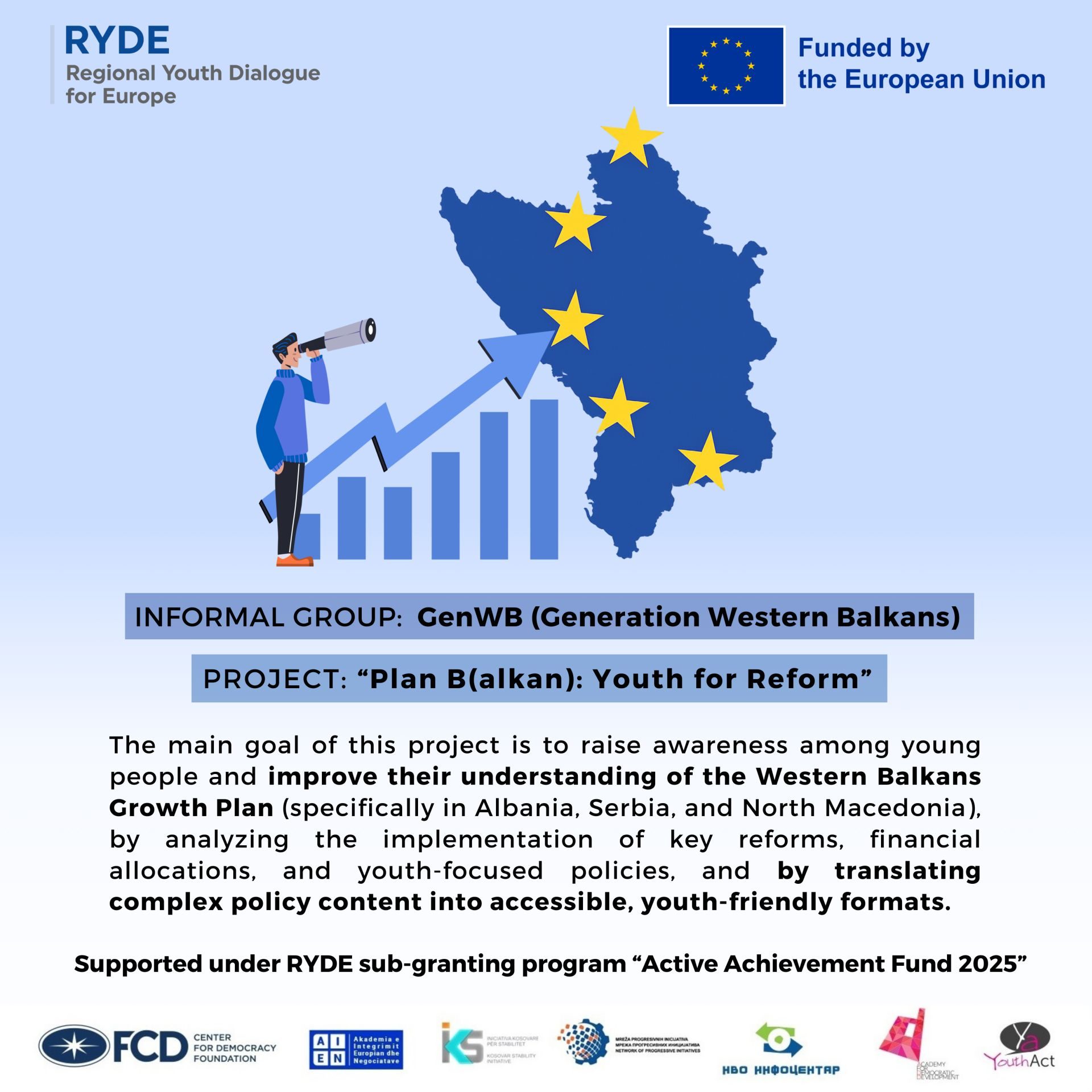
GenWB (Generation Western Balkans) is one of five regional informal groups whose project “Plan B(alkan): Youth for Reform” has received financial support through the “Active Achievement Fund 2025”, a sub-granting activity of the “Regional Youth Dialogue for Europe – RYDE” project funded by the European Union. This group is composed of five young people from North Macedonia, Albania, and Serbia.
The “Active Achievement Fund” aims to empower youth in the Western Balkans to participate in a structured dialogue on public policies relevant to youth, to advocate for the adoption of European values and strengthening of democratic and responsible institutions, and to promote regional cooperation and political, economic and social benefits of the EU integration for the Western Balkans societies. Support is provided through the direct payments by RYDE implementing partner organizations – NGO Info Center from Skopje, North Macedonia, which serve as intermediary organizations for their project.
Project background: The Western Balkans Growth Plan (2024–2027) is a major EU initiative aimed at accelerating regional cooperation, economic development, and reforms in the Western Balkan countries. Despite its transformative potential, especially for young people, there is a serious lack of youth awareness and involvement in the Plan’s implementation across the region. This issue emerged in early 2024, when funding mechanisms and reform procedures began to roll out. While governments and institutions moved forward with policy actions, young people remained largely uninformed or excluded from the process. Information about how the Plan affects key areas like employment, education, digital skills, green jobs and mobility is often inaccessible, overly technical, or not communicated in youth-friendly formats.
The main goal of this project is to raise youth awareness and simplify the visibility process and understanding about the Western Balkans Growth Plan, focusing on Albania, Serbia, and North Macedonia.
 Publication: In order to achieve the project’s goal, the informal group has developed a Comparative Analysis of the Growth Plan’s implementation in the three target countries – examining reforms, funding distribution, and youth-specific dimensions, published in four languages: Macedonian, BSH, Albanian and English. The publication breaks down complex policy frameworks into clear, accessible, and youth-friendly insights, exploring reforms linked to education, employment, funding opportunities, and youth participation. It also highlights common regional challenges, such as brain drain, limited access to opportunities, and weak inclusion of young people in decision-making, while comparing national contexts. Based on the analysis, GenWB puts forward concrete recommendations aimed at making the EU Growth Plan more responsive to the real needs of young people and ensuring that youth are not just beneficiaries, but active actors in reform processes.
The analysis focuses on three main areas for each country (North Macedonia, Albania and Serbia): youth-related reforms within the EU integration process, available opportunities and funding for young people, and the main challenges or gaps that still exist.
Since the Growth Plan is still a new instrument, the analysis is focused more on expected results and potential impacts rather than measurable outcomes. Still, the data gathered gives a good idea of what works and what does not, and where young people can have the biggest influence. In the final part of our project, we will include a conclusion and a set of practical recommendations to help make the Growth Plan more youth-centered and effective in the Western Balkans.
The paper also gives five (5) Recommendations to Enhance Youth Impact from the EU Growth Plan in the Western Balkans:
- Strengthen Education-to-Employment Pathways – Governments should align curricula with labor market needs, particularly in digital, green, and technical sectors, while expanding vocational education and apprenticeship programs. Programs should also build soft skills, entrepreneurship, and civic engagement to prepare young people not only for employment but also for active participation in society and policymaking.
- Increase Access to Funding and Opportunities – EU programs such as Erasmus+, Horizon Europe, and regional mobility initiatives must be widely promoted, especially among rural and marginalized youth. Targeted financial instruments, including seed funding, microloans, and innovation vouchers, can support youth-led initiatives and start-ups, fostering innovation and entrepreneurship locally.
- Enhance Youth Civic and Political Participation – Governments should create platforms such as youth councils, advisory boards, and digital engagement tools to involve young people in monitoring and evaluating reforms. Institutional capacity and transparency must be strengthened, and youth-specific indicators should be used to ensure EU backed funds benefit all youth, including those in underserved areas.
- Address Brain Drain and Retain Talent – Incentives such as scholarships linked to local employment, subsidized start-up incubators, and career mentoring programs can encourage skilled youth to remain and contribute locally. Regional cooperation initiatives should also be expanded to enable cross-border collaboration, allowing youth to gain experience while staying connected to their home countries.
- Promote Financial Inclusion and Practical Skills – Tools like SEPA should be leveraged to facilitate cross-border payments, internships, and entrepreneurship. Governments and youth organizations should provide training to young freelancers and entrepreneurs to navigate the European single market effectively. NGOs and youth organizations should act as partners in designing programs, implementing initiatives, and advocating for youth needs, ensuring that the Growth Plan delivers tangible opportunities and empowerment for the next generation in the Western Balkans.
Online campaign: In order to make the Growth Plan real and relatable, the informal groups members presented the SEPA (Single Euro Payments Area) Simulator, a powerful tool for financial literacy and EU integration readiness through creative and youth-friendly video content. They created short, engaging video reels explaining the SEPA real-life benefits for young people in areas such as travel, freelance work, and digital banking, while promoting financial literacy. These videos used humor, storytelling, and real-world scenarios to make the content both informative and entertaining.
CDF / RYDE
Instagram Reels:
The Regional Youth Dialogue for Europe Project is implementing by the Center for Democracy Foundation (CDF), Belgrade (as project coordinator) and partner organizations: Academy of European Integration and Negotiations from Tirana (AIEN); Kosovo Stability Initiative from Pristina (IKS); Association Network of Progressive Initiatives from Sarajevo (NPI); NGO Info Center from Skopje (NGO IC); Regional Academy for Democratic Development from Novi Sad (ADD); Youth Act Center from Tirana (YA). The project is funded by the European Union.
Regional Youth Dialogue for Europe – RYDE
Project is funded by the European Union.