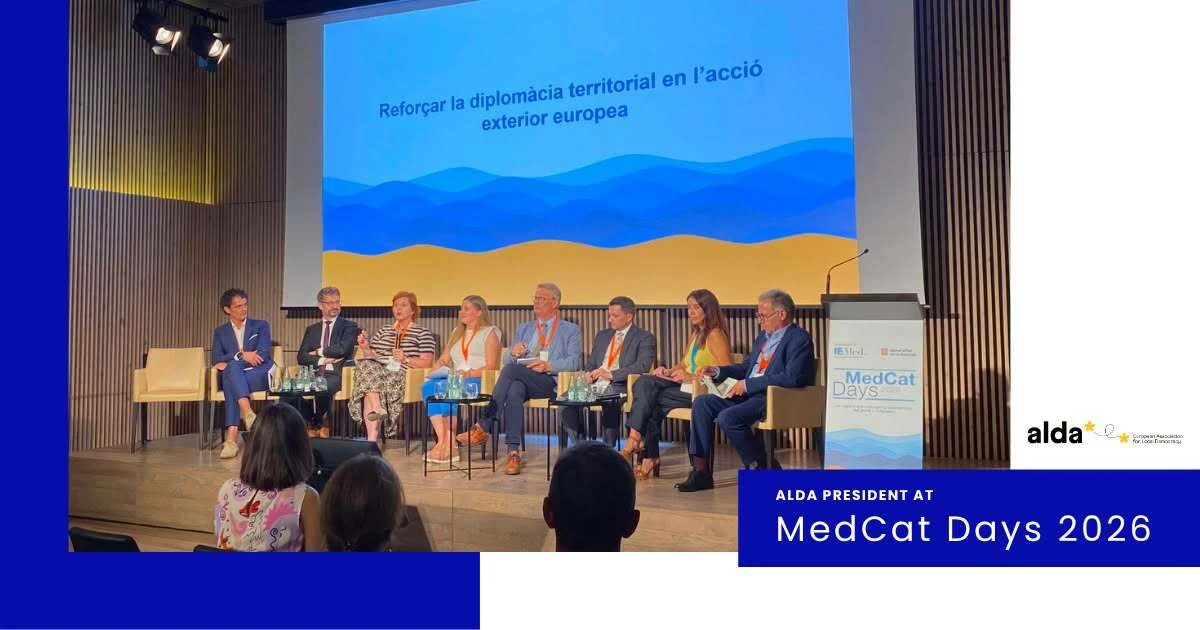
On 9–10 July 2026, ALDA President Natasa Vučković participated in the 7th edition of MedCat Days, organised by the Government of Catalonia in collaboration with the European Institute of the Mediterranean (IEMed). The event brought together representatives of European institutions, regional networks, local and regional authorities, and civil society to discuss how to transform the Pact for the Mediterranean into concrete, place-based action.
The MedCat Days 2026 addressed how Mediterranean governance can become more effective,coordinated and action-oriented within the framework of the new Pact. The first day focused on the operational dimension of the Pact, addressing how it can be implemented in practice through governance and coordination mechanisms, territorial approaches, and concrete projects and partnerships that support delivery on the ground. The second day shifted to the political and strategic dimension, examining how the Pact is shaped and influenced. (Source: Government of Catalonia)
Representing ALDA during the policy exchange “Enhancing Territorial Diplomacy in Europe’s External Action”, President Vučković contributed to the debate on strengthening the role of local and regional authorities in the EU’s neighbourhood, enlargement and cooperation policies.
Opening her intervention, she stressed that the future of Euro-Mediterranean cooperation depends on empowering local actors:
“As we discuss moving ‘from Pact to Impact’, we must recognise that the impact we seek cannot be achieved through top-down mandates alone. True impact is grown from the ground up.”
She highlighted that territorial diplomacy means recognising local authorities, regional networks and civil society organisations as essential partners in shaping European external action, rather than simply implementing it.
Drawing on ALDA’s nearly three decades of experience in promoting local democracy, President Vučković presented the Association’s multilevel governance model, built on partnerships between municipalities, civil society and international institutions. She underlined the role of ALDA’s network of 19 Local Democracy Agencies, describing them as proven platforms for fostering democratic resilience, citizen participation and sustainable local development in Europe, the Mediterranean, Africa and the Eastern Neighbourhood.
During her speech, she also shared ALDA’s experience in supporting democratic resilience in fragile contexts, emphasising the importance of flexible funding mechanisms, long-term capacity building for grassroots organisations, co-creation with local authorities and spaces that encourage meaningful citizen participation.
“The alliance between local and regional governments and civil society is key for democracy and sustainable development.”
Referring to ALDA’s ongoing work in Ukraine, President Vučković highlighted how cooperation between municipalities and civil society has become a fundamental pillar of resilience and reconstruction. She welcomed the growing collaboration with Catalonia in this field and pointed to initiatives such as the Shoulder to Shoulder programme as concrete examples of territorial partnerships delivering tangible results.
She also called for stronger consultation mechanisms within the European Union to ensure that local and regional voices are systematically integrated into the design and implementation of EU external policies.
“We think this dynamic is extremely important to bring the voice of local authorities and grassroots members to the higher levels, and we wish for consultation mechanisms to be further integrated by proactively including local voices.”
Over the two days, discussions focused on the territorial implementation of the Pact for the Mediterranean’s Action Plan, covering topics such as climate action, youth mobility and participation, science diplomacy, water resilience, entrepreneurship, port cooperation, wildfire prevention and early warning systems. Participants also explored how territorial diplomacy can become a stronger pillar of the EU’s external action, contributing to the development of a future Manifesto on Territorial Diplomacy.
Several common messages emerged throughout the event. Participants agreed that the Mediterranean faces increasingly complex challenges, from geopolitical tensions and conflicts to migration and climate change, but also offers significant opportunities for cooperation and shared development. They stressed the need for structured mechanisms that give local and regional authorities a meaningful role in European decision-making and emphasised that the priority should be to strengthen and better coordinate existing initiatives rather than creating entirely new instruments.
ALDA’s participation in MedCat Days 2026 reaffirmed the Association’s commitment to promoting local democracy, decentralised cooperation and multilevel governance as key drivers of a more resilient, inclusive and interconnected Mediterranean.
Source: ALDA