Local Dialogue Session in Niš, 10 February 2026
On 10 February 2026, in Niš, the Center for Democracy Foundation organized, within the project “Labour Rights and Decent Work in Socio Economic Reforms in Serbia – Black and White”, with the support of the Olof Palme International Center, a local dialogue session entitled “Draft Law on Internships: Between Better Youth Employability and the Risk of Abuse”.
At the end of 2025, the public consultation on the Draft Law on Internships was concluded. The proposed law is intended to enable a quality transition of young people from education to the world of work. By adopting the Law on Internships, a systemic regulation of internships would be introduced into the legal system of Serbia for the first time, with the aim of increasing youth employability and enhancing their competitiveness in the labour market.
The proposer defined an internship as activities performed by an intern with an employer under the support and supervision of a mentor, aimed at acquiring practical skills and work experience in a specific occupation in order to improve employability, that is, to create opportunities for employment and self-employment.








The discussion at the Media and Reform Center in Niš included: Jovana Misailović, Faculty of Law, Kragujevac; Dragoslav Ćirković, Company PAVLE; Nikola Bobić, Confederation of Autonomous Trade Unions of the City of Niš; Slađana Miletić, Member of Parliament, New DSS; Dimitrije Nešović, Youth Empowerment Club 018; Slavica Petrović, Association of Disenfranchised Workers and Socially Marginalized Citizens; Miodrag Stanković, City Councilor, Niš My City; Nataša Vučković, Secretary General of the Center for Democracy Foundation, and others.
It was emphasized during the discussion that the Law on Internships is important because its objective is to improve the position of young people in the labour market. Employment rates among young people are significantly lower than among older generations, while at the same time there is a large number of young people who are neither in education nor in employment. Furthermore, there is often a considerable period of time between the completion of education and finding employment in one’s profession. The Law on Internships aims to bridge that time gap, providing young people with an opportunity to gain their first work experience and develop work-related skills.
It is of great importance that such regulations are adopted with the participation of young people and local communities. The Draft Law on Internships has positive elements, but also provisions that need to be improved. It is essential that internships serve as a bridge to stable employment for young people, rather than a substitute for regular employment. A mandatory financial allowance has been introduced, and the role of mentorship has been recognized as a key element of the law. The discussion also addressed issues such as liability for damages, protection of women and maternity rights, monitoring and reporting on the effectiveness of internships, incentivizing employers through state-provided benefits, and others. It is important that the highest possible quality law enters parliamentary procedure, and youth representatives emphasized that it is important not only that the law be adopted, but also that it be effectively implemented. It was underlined that a better solution would have been for this law, like all regulations concerning labour and the right to work, to be encompassed within a single integrated framework, the Labour Law.






The Law on Internships is also important in the context of the Youth Guarantee, a programme through which Serbia and other Western Balkan countries build upon European practice in seeking to provide young people who are neither in education nor in training with better access to the labour market. The Youth Guarantee is part of a broader policy on human capital development in Serbia, one of the policy areas included in the Reform Agenda stemming from the EU Growth Plan for the Western Balkans, aimed at reducing the socio-economic development gap between the Western Balkans and the European Union.
The Center for Democracy Foundation is committed to the protection and advancement of social rights, particularly labour rights. We promote public dialogue and the principle of citizen participation in decision-making and public affairs. We believe it is important that citizens are informed about public policies, but also that they have the opportunity to express their views, identify needs, and point out positive or negative practices of institutions, companies, or public administration.
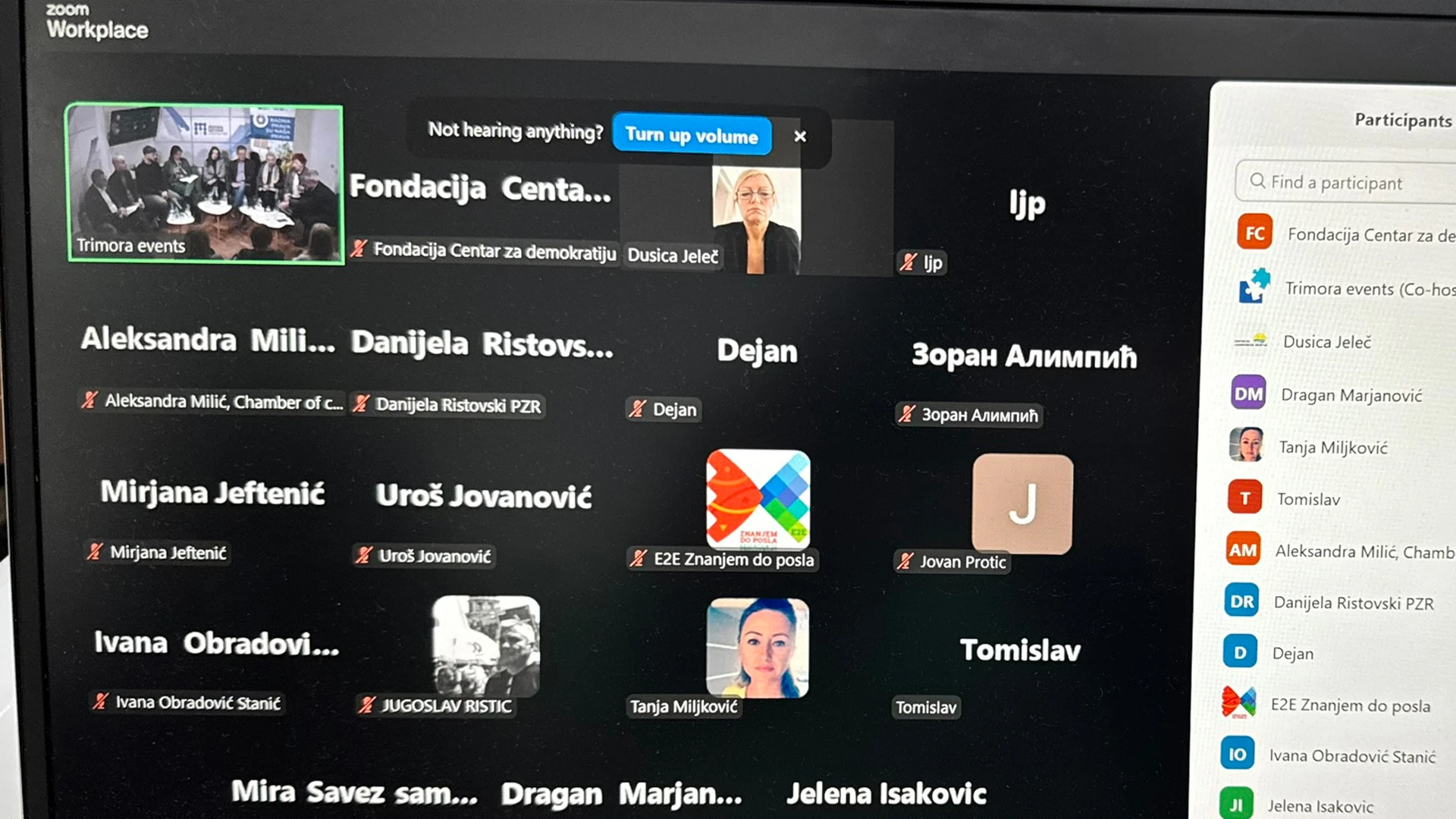
The debate in Niš was organized with the aim of fostering an inclusive public dialogue within the local community on the potentials, challenges, and possible improvements of the future Law on Internships, as well as on opportunities to improve the position of young people in Serbia. The dialogue brought together decision-makers, Members of Parliament, representatives of youth organizations, trade unions, employers, independent institutions, academia, civil society organizations, educational institutions, and the media.
Center for Democracy Foundation
Photo/video: MIRC, CDF