Panel discussion ‘Economic Challenges and Changes in the Labour Market During COVID’
Along with the Center for Advanced Economic Studies (CEVES) acting as partner, we organised one additional discussion, the topic of which arises from the crisis caused by the COVID-19 pandemic. The discussion, under the title ‘Economic Challenges and Changes in the Labour Market during COVID’ was held on an online format on Wednesday, 1 July 2020, within the ‘Sustainable Development for All’ project with the support of the governments of the Swiss Confederation and the Federal Republic of Germany in cooperation with the Ana and Vlade Divac Foundation and the Belgrade Open School, as well as with partners Timočki Youth Center and the Belgrade Fund for Political Excellence.
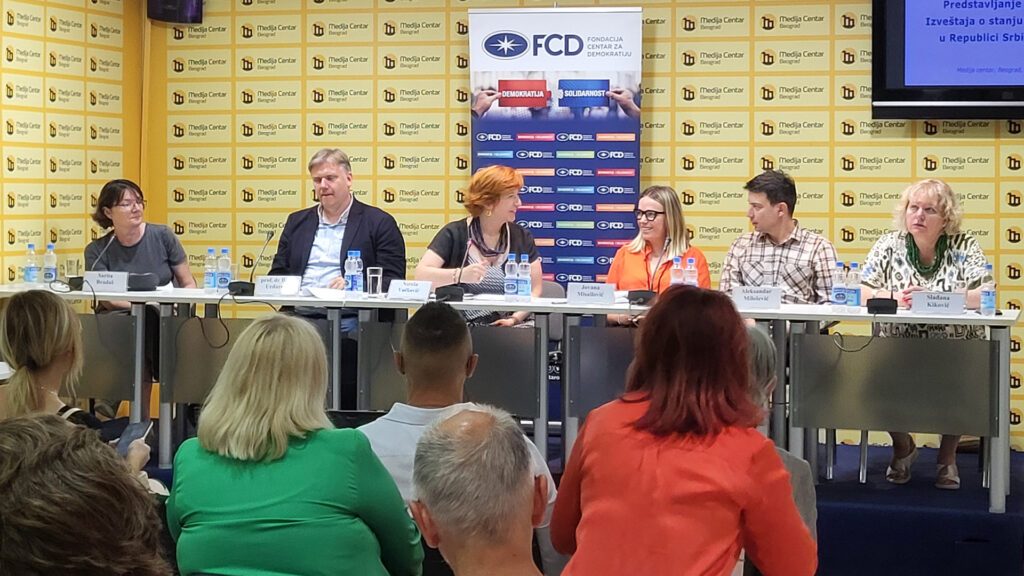
The Center for Democracy Foundation was represented by our Researcher, Sarita Bradaš who spoke about labour market conditions during the state of emergency, the consequences both the crisis and Government measures had on employee rights, especially in terms of respecting the principles of decent work.
The framework for this discussion is the United Nations Sustainable Development Goals (COR/SDG), Sustainable Development Goal No. 8 – Economic Growth and Decent Work (COR 8), in the context of the socio-economic consequences of the COVID-19 pandemic.
 In addressing the participants, Kori Udovički (CEVES) pointed out that the project ‘Sustainable Development for All’ should respect the key principle of the Sustainable Development Goals, and this is what makes them inseparable. The global economic crisis of 2007-2008 shed light on the link between economic growth and quality employment. Until then, the Washington Consensus ruled, based on the premise that the market alone resolves economic growth, and that it is only important to have enough, so that redistribution ensures distribution to the poor or to maintaining the environment. The financial crisis, along with the ongoing ideological debates that have continued, has brought awareness of the fact that development and dignified work are inseparable. She pointed out that Serbia had accelerated economic growth in 2019 and that the crisis caused by the pandemic, cut this off short. In the short-term, today’s projections, predict roughly a 3% drop in economic growth. During the state of emergency, the hardest hit were SMEs (approx. 25%), and large enterprises suffered far less, so that, on average, what we’re talking about is 15-20%. However, SMEs demonstrated impressive resilience, which was partly helped by Government measures, but also by the resourcefulness and working capacity of these enterprises even under difficult conditions. 2019’s drive for growth was based mostly on foreign direct investments, real estate and state infrastructure projects. The vast majority of these projects continued, mostly until March, and this is where things went quiet. Thus, it can be said that the future is uncertain.
At the same time, COVID has shown itself to bring more localisation, so there is more and more talk of the possibilities and hope that foreign investors will move their business from further to closer-to-home locations, due to the weaknesses revealed of global chains. This will not happen overnight, and it will certainly be inevitable for Serbia to join the global value chain in such a way that it will include its domestic industry in these flows, and not simply wait around for foreign partners or investors to take the initiative. It will also do this not by being able to provide quality jobs immediately, but will have to have a positive outlook toward obtaining these types of jobs in future. The following year, year and a half will be difficult and will hit the most vulnerable workforce the hardest, concluded Udovički.
 At the beginning of her presentation, Sarita Bradaš (Center for Democracy Foundation) reminded us of the definition of decent work envisaged by the Agenda of the International Labour Organisation (ILO) and the International Covenant on Economic, Social and Cultural Rights. This definition includes employment opportunities, social protection, labour rights and social dialogue. Serbia was very far from meeting these standards even before the crisis.
In 2019, registered employment, unlike surveyable employment, was 49.5%, and registered unemployment stood at approx. 19%. The share of vulnerable employment in the labour market is high, and these people were most affected by the crisis. There is a large share of both temporary and periodical employees (450,000 in 2019) – who were the first to be hit and the easiest to dismiss. The share of informal work is also high and amounts to about half a million people, half of whom are employed outside the agricultural sector. In Q1 2020, there were fewer self-employed individuals in the formal sector compared to 2019, by 17,700, and in the informal sector by almost 31,000.
As far as social protection is concerned, most of those who were left unemployed will not receive unemployment benefits, as in order to receive this benefit, you need to be employed in the formal sector for at least 12 months or for a year and a half, with interruptions. Only 5% of those unemployed and registered with the National Employment Service receive unemployment benefits, most of whom receive benefits for up to six months in the amount of approx. RSD 15,000, and this year there are fewer than last. Most people will lose both their jobs and unemployment benefits.
The average salary has increased by 1.3%, but most employees do not receive it. On the other hand, median earnings in April decreased compared to February 2020.
As far as social dialogue is concerned, in terms of adopting measures, the unions were completely excluded from the story. Under regular circumstances, social dialogue was just a game, and in extraordinary circumstances it was completely non-existent, concluded Sarita Bradaš.
 Jovan Protić (ILO) informed participants on how the International Labour Organisation measured the impact of Covid on employment. One type of database of all measures taken by member states during the pandemic was presented in April. A survey was conducted with employers, administrative data were collected from national employment services and other state bodies and agencies. The data were crossed on the basis of a model that aimed to calculate how many jobs were lost and this was then converted into ‘full-time job equivalents’, i.e. in the form of 8-hour, full-time employment. These data do not necessarily refer to those who will lose their jobs, but to the amount of work and productivity, and thus the possibility of creating additional wealth.
In Q1 2020, roughly 5.4% of working hours were lost globally, of which Asia lost 7.5%, which translated into full-time equivalents as following: the equivalent to 155 million jobs ceasing to exist overnight. In Q2 2020, the focus of the crisis shifted to Europe and America, where about 14% of global working hours were lost, equivalent to 480 million jobs. Before the Covid crisis hit, registered unemployment stood at 180 million people.
On the global labour market, there were four types of responses to the crisis: 1. shortening of working hours; 2. persons who were officially registered as employed but did not actually work; 3. classic unemployment, i.e. unemployed people looking for work but are unable to find it, and 4. complete inactivity, i.e. withdrawal from the labour market.
According to the data, Europe was somewhere in the middle – in the second quarter, 14% of working hours were lost, which is the equivalent of 45 million jobs. In Serbia and the region, the situation does not differ from Europe significantly. In Q1, 5.5% of working hours or 190,000 full-time equivalent jobs were lost, and in Q2 14.8% working hours or 510,000 full-time equivalent jobs were lost. Real short-term and long-term unemployment will be measurable only in Q4.
The ILO is attempting to create different scenarios depending on whether there will be a second wave of the epidemic. If a second wave follows, the pessimistic projection is that the decline in production will be close to 12%, with Europe and Asia being hit the least. In Serbia, decent employment is less than 50%, and those who work earn less than the median.
 Jelena Žarković (Faculty of Economy, University of Belgrade) believes that we have not rid ourselves of the virus and that we will have to live with it for a long time, and for this reason it is important to look to the future and find solutions in this new situation we find ourselves in. Also, it is obvious that no one is thinking about complete closure any longer and now the key question is how to organise life over the following year. The package of measures adopted during the state of emergency (deferral of tax obligations, moratorium on loans and assistance to employees) is very similar to the measures adopted by other European countries. These measures were not targeted despite the increased vulnerability of certain branches over others. The priority was obviously to react quickly to the situation. As Jelena Žarković concluded, the key questions for us now are: how will education function? how will priority financing of the healthcare system be provided? how will companies reorganise their work without endangering their operations?
 Branka Anđelković (Public Policy Research Centre) pointed out the unique position of those employed in manufacturing who cannot switch to online work. Only those employees in better paying jobs were protected because they could work remotely. One piece of interesting data is the large decline in working hours of digital workers in Serbia on global platforms, and this requires additional analysis. Certainly, in Serbia, it is a completely new that at least every other company has, at least partially, switched to some form of online work, so now one of the tasks is to provide conditions and support to employers to organise this way of working, while ensuring as few obstacles as possible.
The aim of this panel was to achieve a dialogue between experts and other stakeholders who can comprehensively present economic trends that have emerged from the state of emergency, and above all, their impact on the labour market and the socio-economic position of vulnerable groups. In the development of government policies, plans and economic measures, the focus must remain on vulnerable groups. The key issue will also be the initiation of social dialogue and the strengthening of international cooperation.