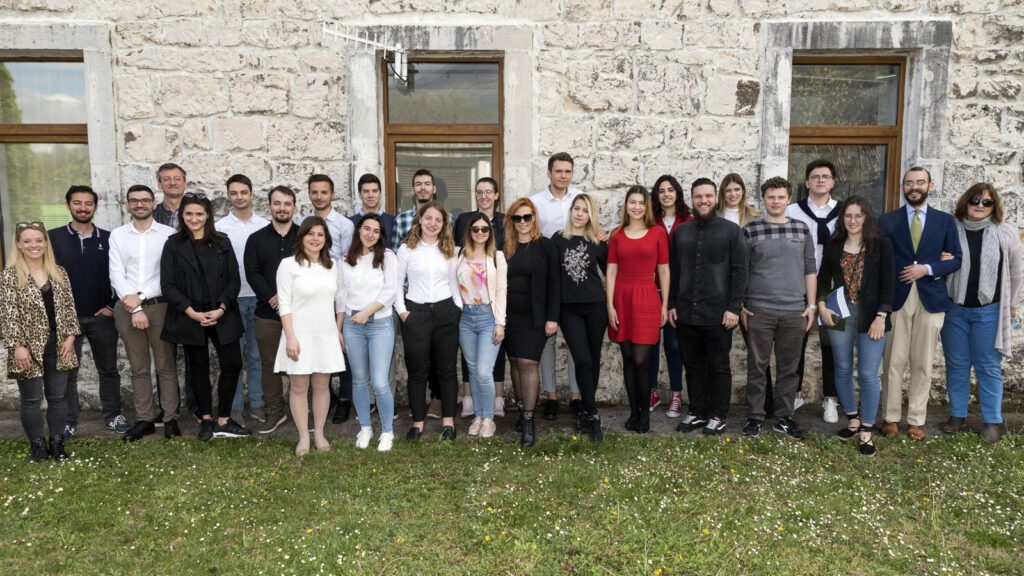

With the Center for Democracy Foundation as the lead partner, for the first time, 14 civil society organizations from the Western Balkans and Turkey united around a single goal—to strengthen the capacities of civil society organizations (CSOs), especially youth organizations, to participate more effectively in policy-making and in monitoring the European integration process.
KEY INFORMATION ABOUT THE PROJECT
“Regional Youth Compact for Europe / Youth of the Balkans for Europe” is one of those projects that all civil society organizations can be proud of. It began in the spring of 2018 with a meeting with the Local Democracy Agency (LDA) Subotica and, over three years—until the Final Conference on July 1, 2021—grew into what is likely the largest regional endeavor of its kind.
As the lead partner, the Center for Democracy Foundation—together with the European Association for Local Democracy (ALDA), nine Local Democracy Agencies from the Western Balkans that form the Balkan Network for Local Democracy, CRTA, Youth Act Center Albania, and SODEM from Turkey—worked toward a single goal: to strengthen the capacities of civil society and youth organizations to monitor the European integration process at the local level, implement reforms, and advocate for youth-relevant policies through structured public dialogue.
It was a journey rich in new experiences, activities, and challenges. The COVID‑19 pandemic broke out precisely when we had planned most activities at the local level. We had to respond more promptly and with excellent coordination, keeping pace with the new reality of digital platforms and online campaigns.
Our team consisted of experienced activists, researchers, communications experts, managers, trainers, and authors—people with clear goals and high expectations—which contributed to all planned activities being carried out to completion. One action led to another, while the lessons learned were woven into each subsequent stage of the journey.
Our goal was to empower, connect, and encourage the main target groups—CSOs and youth organizations—to play a greater role in monitoring reforms and engaging in structured dialogue with governments, both at the local and national levels. Two areas were at the center of our attention. The first covered issues from Chapter 23 (the part of EU accession negotiations concerning the judiciary and fundamental rights)—democracy, the rule of law, and fundamental rights; the second related to the social dimension of the European integration process—employment, social policy, and the fight against poverty.
Our key activities were undertaken in LDA communities, as well as at the regional level, such as the Politeia School and the Youth Fund “We Have a Say.” We advocated for accelerating reforms, for inclusive dialogue among all actors of change, for active citizenship, and for regional cooperation.
Through regional networking, public campaigns, and a small‑grants program—and above all, through the exchange of knowledge and the opportunity for young people to collaborate with CSOs in the region—we fulfilled the raison d’être of the project: we increased the impact of civil society organizations on reform processes that will bring the Western Balkan countries closer to the EU.
One of RYCE’s goals was to strengthen the Balkan Network for Local Democracy (BNLD), a regional organization that promotes active citizen participation, the principles of democratic governance, local development, and cooperation between civil society organizations and local authorities in the Western Balkans. RYCE supported BNLD through organizational restructuring and capacity‑building in the form of training, workshops, and mentoring; by creating platforms for participant exchange and research; and by establishing networks and links between CSOs and local authorities. In implementing project activities, BNLD worked with local actors to build regional engagement and active citizen participation.
Regional Thematic Forums
Regional thematic forums were organized to plan, monitor, and evaluate local and regional activities.
The first forum, held in Tirana in 2019, launched joint activities that included local and regional thematic CSO networks and youth groups so that they could effectively contribute to raising awareness, reporting, and monitoring the progress of Western Balkan countries toward EU integration. The organizers were ALDA and the Youth Act Center Albania. The forum brought together 72 representatives of the civil sector and youth from the Western Balkans and Turkey. Participants addressed two main areas. The first was the rule of law, fundamental rights, social policy and employment, and public administration reform; the second concerned creating a more enabling environment for the participation of civil society and youth in structured policy dialogue, strengthening capacities for reporting, monitoring, and advocacy activities to promote the implementation of reforms related to European integration. Panels were devoted to European and regional policies for cooperation with youth, as well as ways to bring the European integration agenda closer to young people.
The second Regional Forum, held in 2021 in Subotica, focused on the following thematic issues: developing effective public consultation mechanisms; participatory approaches to policy‑making reforms in areas relevant to accession negotiations—rule of law, good governance, fundamental rights, employment, and social cohesion. Experts and practitioners from NGOs, think‑tank groups, local self‑government and national institutions, the business sector, and the media from across the region took part.
The third Regional Forum in 2021 aimed to deepen the debate on opportunities for the young generation to work together. The organizer therefore invited participants from all previous youth‑oriented activities—network members, participants of earlier Forums, alumni of the Politeia School, CSO beneficiaries of the Youth Fund, and youth organizations—to share their ideas and discuss a possible continuation of the RYCE project. At the Forum, the authors of the study presented results and recommendations from “The Transformative Potential of Youth in EU Integration Processes and the Western Balkans after the COVID‑19 Pandemic.”
Regional Youth Workshops
The first workshop was held in 2019, organized by LDA Mostar, to encourage young people to join existing organizations and to form their own thematic networks focused on areas such as the rule of law and fundamental rights, employment and social cohesion, and public administration reform. We explained why this is important for youth and how young people can contribute to monitoring reforms in these areas. Twenty‑eight young people from Serbia, Bosnia and Herzegovina, Montenegro, Albania, Kosovo*, and North Macedonia took part.
The second workshop, organized in 2019 by LDA Kosovo in Pristina, deepened young people’s shared understanding of EU accession negotiations, with a particular focus on Chapter 19 (Social Policy and Employment). The main topics of this workshop were labor‑market reforms, decent‑work standards and social cohesion, employment opportunities, and regional mobility.
Local Youth Workshops
RYCE – We Are Europeans
Around 30 workshops were organized in towns across the Western Balkans with the aim of sharing participants’ knowledge—acquired through trainings and regional forums—with youth associations in local communities, as well as motivating youth organizations to take an active role in implementing the Regional Youth Dialogue for Europe project.
Regional Youth Forum – “We’ll Do It Together!”
Held in 2019 in Pristina, the forum brought together 57 participants from youth organizations across the Western Balkans and achieved its goal—the establishment of the Youth of the Balkans for Europe Network, whose members would put into practice the knowledge gained during the Forum.
Networking focused on accelerating reforms in the Western Balkan countries and revitalizing the European integration process. It also served as a platform to call on governments to implement policies aligned with youth priorities in the region—access to quality education, good jobs, open prospects for career advancement, greater mobility, and more inclusive governance.
Together with project partners, participants developed a Youth Declaration on regional cooperation and identified common problems such as high youth unemployment, a lack of youth participation in policy‑making, brain drain, gender equality, environmental protection, and the rise of Euroscepticism among their peers. They also highlighted the need for a regional approach to overcoming these problems.
Politeia Becomes a Regional School for Youth from the Western Balkans
The regional school “Politeia Western Balkans School for Youth Participation” brought together a large number of committed young people, renowned lecturers and experts, decision‑makers, and representatives of the academic community from the region and European institutions for high‑quality discussions on a range of current and relevant topics.
The first regional Politeia was held in Danilovgrad in 2019, in cooperation with LDA Montenegro. One hundred applications were received and 24 students from Albania, Bosnia and Herzegovina, Kosovo*, Montenegro, North Macedonia, and Serbia were selected.
Participants improved their knowledge of European integration and became better acquainted with the concepts of the rule of law and social cohesion. They also learned about the public‑policy decision‑making process and, through practical exercises, acquired skills for monitoring policy impact and results and for preparing proposals for their improvement. Students were given the opportunity to evaluate the school’s program, and we highlight one participant’s view which, in short, shows that we achieved our goal:
“We want to learn through practice and share our experience with young people from the region. Dialogue is important everywhere in the region, including dialogue among youth. Therefore, I expect to build a network of friends and to learn how we can be more active in monitoring what our governments are doing.”
The second regional school was postponed until the spring of 2021 due to the COVID‑19 pandemic, which provided an opportunity for further reform—Politeia Goes Digital.
We created the first online regional platform for democracy, known today as the Politeia Institute. It is intended for young people, but also for all citizens who wish to enrich their knowledge and contribute to the development of society by exchanging ideas and creating new programs for the development of democracy, civic activism, and cooperation—both in their own countries and with people in the Western Balkans and in the European Union.
Thirty students participated in the first digital program, at the panels “Youth of the Western Balkans—Agents of Change” and “The 3Es in the Western Balkans—Economy, Energy, Ecology.”
The Politeia Institute develops programs in the following areas: democratic institutions, EU integration, promotion and protection of fundamental rights, youth and employment, citizen participation in decision‑making, principles of good governance, multiculturalism in management and business, global processes, and socio‑economic development.
Internship Program
We organized a program that enables youth exchanges and provides first‑hand experience of how civil society organizations function and how to participate in them. It also helped create innovative, youth‑friendly content and forms of communication that lead to greater youth participation in civic initiatives, policy‑making, and effective dialogue. Participants selected through a public call were given the opportunity to undertake internships in another country in the region, at the headquarters of project partners.
Youth Fund “Our Voice Should Be Heard” (RYCE Youth Fund)
The goal of this sub‑granting program is to strengthen democracy in the Western Balkans by providing support to local youth organizations that advocate active participation of young people at the local level. In 2020, within the EU project “Youth of the Balkans for Europe,” the Center for Democracy Foundation officially awarded grants to selected local youth organizations. The total Youth Fund amounted to €78,000.
Published Comparative Studies
- “Civil Society Involvement in Monitoring EU Accession and EU Integration Processes in the Western Balkans—from Initial Projects to Structured Dialogue,” published in 2019. Prepared by project partner CRTA, the study identifies the practices and potential of civil society to participate in and contribute to decision‑making and dialogue on reforms relevant to EU accession processes. The first part covers Montenegro and Serbia, which began accession negotiations, while the second covers Albania, Bosnia and Herzegovina, Kosovo*, and North Macedonia. The focus is on civic participation and monitoring in areas related to the most demanding chapters (19, 23, and 24): social policy and employment; judiciary and fundamental rights; and justice, freedom, and security. The research also offers recommendations for improving civil society’s contribution to this process.
- At the Regional Youth Network Forum in July 2021, the comparative study “Youth Transformative Potential in the EU Integration Processes and Post‑COVID‑19 Developments in the Western Balkans,” prepared by CRTA, was presented. The study explores and analyzes the key drivers and motivations for youth participation in decision‑making processes and the relationship between that motivation and attitudes toward the EU and its core values. In addition to the authors, project partners, trade unions, academia, independent institutions, and representatives of other CSOs participated in the panel.
RESULTS ACHIEVED
- Fourteen civil society organizations in the Western Balkans were empowered to increase their participation in the reform process that brings us closer to the European Union, in public dialogue, and in influencing policy; sixty activists broadened their knowledge through good practices within the exchange program.
- We brought the EU integration process closer to citizens: thousands from various parts of the region took part in debates, workshops, forums, and conferences. Through diverse channels we enabled dialogue with policy makers, businesses, and CSOs. We also reached citizens through our newsletters, media appearances, and online actions.
- Across ten social‑media campaigns we published several hundred posts, several dozen press releases, and forty blogs. In just one project year we designed and sent monthly newsletters to more than 1,000 addresses, while the Center for Democracy Foundation’s monthly bulletin was sent to nearly 2,000 addresses. Two documentaries and one animated film were recorded and published.
- Guided by the idea—to learn a lot, discuss even more, exchange knowledge and practice, launch initiatives, and create projects—700 young people from the Western Balkans participated in local workshops; 196 took part in Regional Thematic Forums; and 57 young people participated in the RYCE Forum.
- Of 64 local youth organizations that applied from Albania, Bosnia and Herzegovina, Kosovo, Montenegro, North Macedonia, and Serbia, the best 14 received grants for their projects, which brought valuable results to local communities.
- The Politeia School became a regional program and then a digital platform for development and education. Fifty‑five participants took part in the first new courses.
- The Balkan Network for Local Democracy was officially registered as a network. It strengthened its capacities and expanded its experience and reach.
- ALDA and its members renewed their presence in the Western Balkans; the Center for Democracy Foundation became an ALDA member, and in 2020 the CDF’s Secretary‑General was elected to the Board of this European association.
- Three years of joint work in such a large consortium were rich with lessons learned for our team, and the experience gained became the basis for our future endeavors, in which large consortia with such excellent members are always invaluable.
Center for Democracy Foundation