
How have the measures put into place to mitigate the effects of the epidemic impacted society?
Author: Ivan Sekulović The traditional folk saying "measure thrice, cut once" does not seem to hold much clout in Nemanjina Street. Not a single decision rendered by the Serbian Government during the COVID-19 epidemic was done so on the basis of prior analyses of their expected impact on society. Moreover, there was no indication of initiating any form of public debate in this regard, not even as a symbolic gesture. Rendering decisions at the highest level was shrouded in an obscure veil of ‘let’s let the experts handle this’ (crisis headquarters were set up, where medical staff had the last…
LAWGEM Online Conference
On Monday 25th May from 10 do 14.30h, the Faculty of Law of University of Belgrade is organizing ONLINE conference Gender Competent Legal Knowledge. This Conference is a part of project `New Quality in Education for Gender Equality – Strategic Partnership for the Development of Master`s Study Program LAW AND GENDER` /LAWGEM/. Center for Democracy Foundation is the associate media partner of Faculty of Law on the LAWGEM project. The Faculty of Law University of Belgrade has been coordinating the prestigious European project `New Quality in Education for Gender Equality – Strategic Partnership for the Development of Master`s Study Program LAW AND…
Happy Europe Day
On 9 May 1950 French foreign minister, Robert Schuman proposed the creation of an organised Europe. The Schuman Declaration is considered to be the beginning of the creation of a great European community based on the values of freedom, democracy, human rights, i.e. today's European Union. The European Community emerged as a need of European countries to overcome the consequences of World War II, to lay new foundations for security, economic progress, social development, tolerance and solidarity. The establishment of such a Community, comprised of nation-states with long-standing traditions, historical experiences and a varied degree of development, could not have…
Bradaš: 69,000 in Serbia are employed through a temporary or periodical contract-basis, exempt from the state package

“In the first three months of 2020, over 69,000 people in Serbia were registered as working under temporary or periodical employment (T/PE) and these individuals are exempt from the aid package offered by the state of three minimum-wage salaries granted to mitigate the consequences of the Covid-19 pandemic,” said FCD Researcher, Ms Sarita Bradaš. She told Beta that in the first quarter of this year, 23,155 T/P employed workers were engaged in the public sector, while 45,943 T/P employees were engaged in the private sector. Bradaš said that employees hired under T/PE are usually those working in construction and processing…
Labour Rights in Serbia During the Pandemic
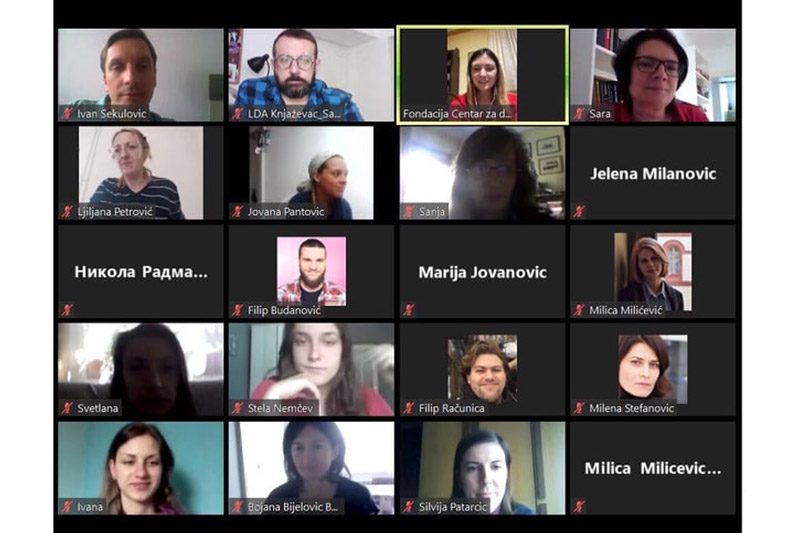
In collaboration with the Local Democracy Centre (LDA) Knjaževac and the LDA Subotica, the Foundation Center for Democracy organised an Online Workshop for youths on the subject of labour rights, as a part of the project Regional Youth Compact for Europe. The following webinar was held on 5th May via Zoom platform: Labour Rights in Serbia During the State of Emergency. Approximately 30 representatives of NGOs, trade unions and interested youths from Knjaževac and Subotica participated in this discussion. What labour rights are guaranteed through international documents? What role do youths play in the world of work in our country?…
Parliament and the Pandemic – What is there to be done?
Author: Nataša Vučković An appeal to governments of the Western Balkans to enable their respective parliaments to resume their work, made last week by Tanja Fajon MEP, and backed by the European Parliament rapporteur for Serbia, Vladimir Bilčik, once again refocused our attention on the stillness that has permeated our National Assembly since the second week of March. In deliberating on whether or not the National Assembly could have convened to declare a state of emergency, both those in favour and those opposed make valid points. Perhaps the risk was indeed too high and technically speaking, there wasn’t enough time…
National Convention on the EU on the Impact of the Crisis on Labour Rights in Serbia
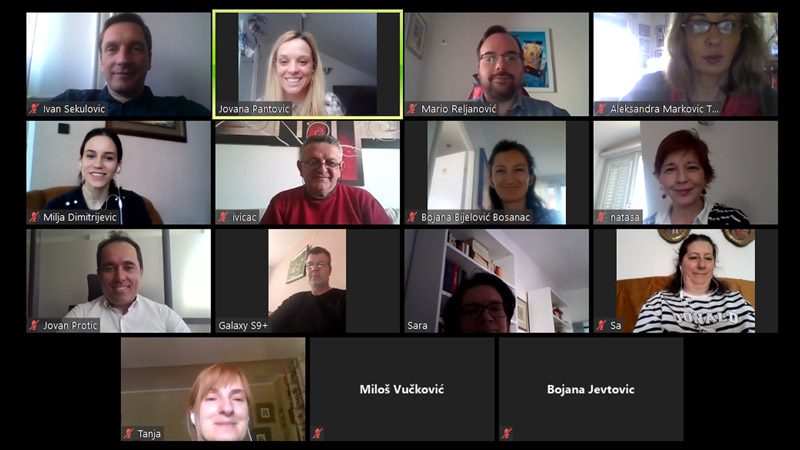
Adherence to the measures for protection and safety at work, layoffs and the issue of absence in the time of crisis were the main topics of discussion at the meeting of the Working Group for Chapters 2 and 19 of the National Convention on the EU, held on 9 April 2020, via the Zoom online platform. The Executive Director of the Center for Democracy Foundation, Ms Nataša Vučković, emphasised the importance of engaging organisations and working groups in monitoring changes and implementation of regulations pertaining to labour rights, and the state of labour rights during the pandemic and the state…
Senior Cohousing Communities – a way to overcome loneliness, abandonment and lack of support
Author: Ksenija Petovar Lockdown for those over the age of 65 has made the question of how synchronised are forms/types of accommodation for the elderly, with their daily needs and abilities to actively and rationally organise their daily lives, a hot topic. Generally, we know that Europe’s population is ageing rapidly, that Serbia belongs to the group of European (and Non-European) countries with the highest median age (over 43), that the ageing index (ratio of age contingent 0-19 and 65 and more) in Serbia exceeded 1 a long time ago (the number of elderly citizens exceeds the number of children),…
Communication from the National Convention on the EU about the need for cooperation in the state of emergency
Center for Democracy Foundation (CDF), as coordinator of Working group and a member of the National Convention on EU Program Council, supported the NKEU Communication about the need for cooperation in the state of emergency „The National Convention on the European Union, which brings together more than 700 citizens' associations, calls on state and local governments to recognize civil society organizations as partners in protecting the most vulnerable social groups in the face of the COVD19 pandemic.“ State institutions and citizen associations are on the same mission – the state should recognize civil society as a partner The National Convention…
Center For Democracy Foundation – remote team work
Since 16 March, the Center for Democracy Foundation has been working remotely. Despite all our earlier efforts to stay on top of online teamwork platforms, like most of other organisations and individuals, we are still facing numerous challenges: we have to quickly update software on our computers, to increase internet speed at our homes, to install new software and gain new experience – remote team working. At this moment, our work is focused on analysis and finding solutions for numerous problems aggravated by the ongoing epidemic and state of emergency, which affect our citizens, companies, unions, NGOs, local governments, healthcare…
Project implementation in the era of Coronavirus
Extracted from the Blog of Emilija Dolovački, ALDA Project Coordinator Today on 30 March, the third week of teleworking has already started. Social networks and new technology gained importance and are used more than ever. Although we have all used various online communication platforms already, in this moment everything is completely different. Those platform have become integral part of our daily routine and the only way of communication between employees, both within the organization and with external associates. Meetings of all employees are held at least once a week via Skype. Project team meetings are held on daily basis. All…
Connecting the dots

At the beginning of 2020, the Center for Democracy Foundation launched Connecting the Dots project. The focus of this project is on monitoring reforms in the area of social and economic rights ,and to inform citizens, holders of social rights, about the importance of the European integration process.During the first months of this project, a team of experts was formed – the Socio-economic rights defenders Club, which will provide the public with information on the state of social and economic rights in Serbia, as well as about reforms in these areas, through analysis, research and public campaigns. The first analysis…
