
Financial Literacy as a Pathway to Youth Economic Independence in the Western Balkans

Regional Youth Dialogue for Europe project In today’s rapidly changing economic environment, young people in the Western Balkans face a complex set of challenges. Entering the labour market, achieving financial stability, and planning an independent future often require navigating uncertainty, limited opportunities, and unequal access to information and resources. In this context, financial literacy emerges as a crucial life skill, closely linked to youth economic independence, social inclusion, and long-term social resilience. Social resilience, understood as the ability of societies to withstand and adapt to economic and social challenges, largely depends on the capacities of younger generations. Financially literate and…
Regional Cooperation as a Shared European Value in the Western Balkans

Regional Youth Dialogue for Europe project The Western Balkans has long been a region shaped by history, borders that changed often, and complex political relationships. For decades, the idea of cooperation across borders seemed distant, sometimes even unrealistic. Yet today, regional cooperation is no longer just a political slogan; it is increasingly recognized as a shared European value and a practical necessity for the Western Balkans on its path toward European integration. In a region marked by post-conflict recovery, economic transition, and social change, cooperation among neighboring countries is not only a requirement set by the European Union but also…
How EU Integration Can Restore the Trust of Western Balkan Youth in Democratic Institutions

Regional Youth Dialogue for Europe project Written by Emina Odobašić, a Intern at the Center for Democracy Foundation within the Regional Internship Program under „Regional Youth Dialogue for Europe“ project, supported by European Union During the last two decades, confidence in democratic institutions has been declining among young people across the Western Balkans. Feeling their voice does not count, opportunities are determined by corruption and political connections, public institutions do not provide equal opportunities or justice, many have grown disillusioned. Yet, amidst this overall disappointment, there is one highly shared conviction: the process of European integration can be a turning…
Environmental Issues as Drivers of Youth Activism in the Western Balkan

Regional Youth Dialogue for Europe project Written by Laila Šašivarević, a volunteer at the Center for Democracy Foundation within the Regional Volunteering Program under „Regional Youth Dialogue for Europe“ project, supported by European Union. Apathetic, lazy, and apolitical – these are the adjectives that have been used for years to describe young people, not only in the Western Balkans but globally. However, the situation today seems different. In the context of the transformative student protests in Serbia, last year’s global student protests against the occupation of Palestine and the war in Ukraine, as well as numerous environmental protests led by…
Nataša Vučković: Social and Labour Rights on the Margins of Integration

Authored article by Nataša Vučković for Novi Magazin It is a rare occurrence for a conference addressing the general challenges and prospects of EU membership for Western Balkan countries to dedicate specific attention to the labour market, the state of workers’ rights, and the prospects for socio-economic development. These often seem like two parallel lines that seldom, if ever, intersect. The first set of topics typically revolves around geopolitical realities, the EU’s openness to further enlargement, and a general assessment of each country’s progress, with focus on the fundamentals—democracy, the rule of law, human rights, and regional cooperation. The social…
How Young People Can Contribute to the European Integration Process of the WB6?

Regional Youth Dialogue for Europe project The European integration of the Western Balkans Six (WB6) – Albania, Bosnia and Herzegovina, Kosovo*, Montenegro, North Macedonia, and Serbia – is a crucial process for the stability and prosperity of the region. Young people play a pivotal role in this journey, bringing fresh perspectives, energy, and innovative solutions. Here's how they can make a significant impact: 1. Promoting Cross-Border Collaboration Young people can foster cross-border collaboration by engaging in regional exchange programs, joint projects, and cultural events. These activities help build mutual understanding, trust, and friendships among youth from different countries, laying a…
OP-ED: Where the EU has benefits, the Western Balkans has potential
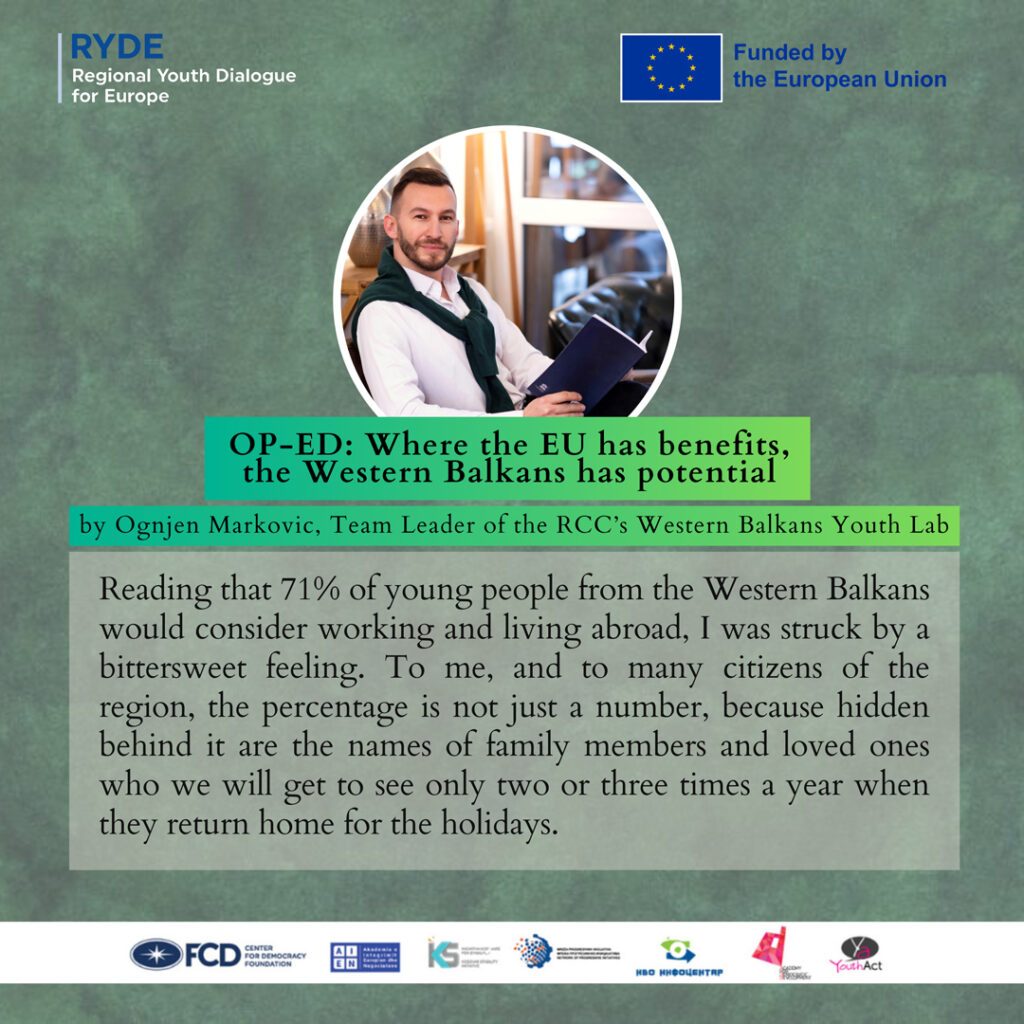
Regional Youth Dialogue for Europe project by Ognjen Markovic, Team Leader of the RCC’s Western Balkans Youth Lab project I was 13 years old when the first person from my close-knit circle of family announced she was leaving Montenegro. Back then I was not yet aware that it was the beginning of a ‘trend’ and that over the next few years I would keep witnessing more and more people I know leaving our homeland to find a living in the EU. Reading that 71% of young people from the Western Balkans would consider working and living abroad, I was struck…
Navigating the EU Youth Dialogue and Strengthening Youth Decision-Making in Serbia

Regional Youth Dialogue for Europe project The EU Youth Dialogue (EUYD), formerly known as Structured Dialogue, is a mechanism implemented at the European Union (EU) level to address youth issues and needs. Through this dialogue, decision-makers gain insight into the concerns and demands of young people, enabling them to make informed decisions that are in the best interest of the youth. Simply put, the EUYD provides a platform for young people to participate in the political decision-making process and make their voices heard. Aligned with the EU Youth Strategy 2019-2027, EUYD supports its implementation and encourages cooperation between EU countries…
Is there any progress in Western Balkan economies in implementing the Youth Guarantee programme?

Regional Youth Dialogue for Europe Project Over the last few years, the youth unemployment rate has continuously decreased in all WB economies. However, it varies from economy to economy and remains higher compared to EU member states. The highest youth unemployment rate is in North Macedonia, at 34.9%, while the lowest is in Kosovo* – 21.4%. According to Eurostat data from November 2023, youth unemployment in the EU stands at 14.5%. A decade ago, this rate was roughly 24%. How did youth unemployment decrease by approximately 10% over the past 10 years in the EU despite the COVID-19 pandemic, the…
Civic and Political Engagement of Youth in the Western Balkans

Regional Youth Dialogue for Europe Project The realisation of the rights of young people to actively participate in the decision-making process is an integral part of every developed democratic society and is guaranteed by the European Charter on the Participation of Young People at the Local and Regional Levels adopted by the Council of Europe. Young people have the right, and should have the opportunity, to fully participate in decision-making that affects their lives at the local and/or regional level. However, due to the insufficient democratic capacity of WB countries, still burdened by the legacy of the last decade of…
Western Balkans Youth in the European Commission’s Progress Report 2023 for WB6

Regional Youth Dialogue for Europe Project Good things come to those who wait – on 8th November 2023, the European Commission published the annual progress reports for the Western Balkan economies for 2023 – the new enlargement package and the Progress Report on European integration process for all WB6. How do these reports assess the progress made by these economies in 2023? To what extent do they address the issues and needs of young people, and do they take into account the involvement of youth in decision-making processes? Just to remind ourselves – Western Balkans consist of Albania, Bosnia and…
Public Monuments – Then and Now
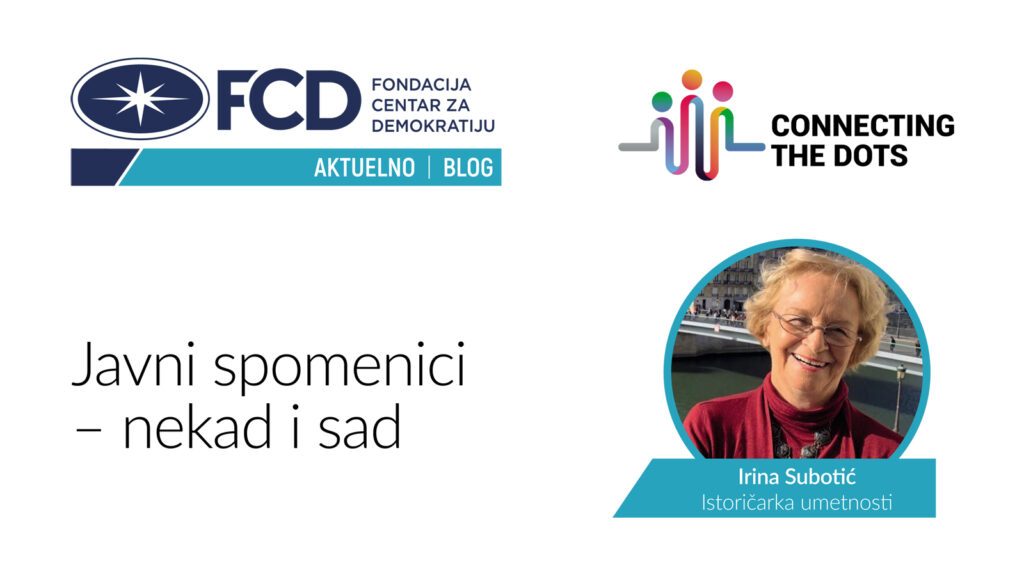
Author: Irina Subotić, Art Historian, President of Europa Nostra Serbia In their essence, the purpose of traditional monuments was to glorify or commemorate; a desire to preserve the ritual of remembering historically significant individuals or events. This tradition, which has developed from ancient times and continues on to this day, has adapted to the times, the genius loci, and the layered meaning, forms and objectives of a society that raises a monument. Each era and every culture have their own specific features which make up the corpus of world civilisation – history, art, urbanism, architecture, archaeology, etc., precisely because they…
