Solidarity with Roma men and women is a task for all of us.
Social inclusion of Roma men and women is one of the most pressing tasks in our country. For our fellow Roma citizens to have equal access to economic resources, to live in better neighborhoods, to prevent discrimination in employment, and to reduce poverty in their families – the engagement of the entire community is needed: the state and local governments, business, and civil society, but also all of us.
These goals are the focus of the project “Inclusion of Roma and other marginalized groups in Serbia”, a German development cooperation program implemented in Serbia by Deutsche Gesellschaft für Internationale Zusammenarbeit (GIZ) GmbH in cooperation with partner institutions and organizations.
The project has provided support to local governments and civil society organizations in implementing local action plans, monitoring the social inclusion of Roma men and women, and linking with other measures carried out locally. This type of exchange is very important because it shows us that there are examples of cooperation between the private, public, and civil sectors that have proven to be good solutions for improving the position of Roma men and women, as well as other marginalized groups in Serbia.
The Center for Democracy Foundation has provided expert support in improving and transferring knowledge between the project team and participants/users of the Program – groups with difficulties entering the labor market and returnee reintegration – in connection with the new National Employment Strategy. We contributed to establishing a coordination platform for aligning social inclusion measures at the public, private, and civil sector levels in six cities and municipalities: Aleksinac, Kragujevac, Kruševac, Pirot, Subotica, and Vranje.
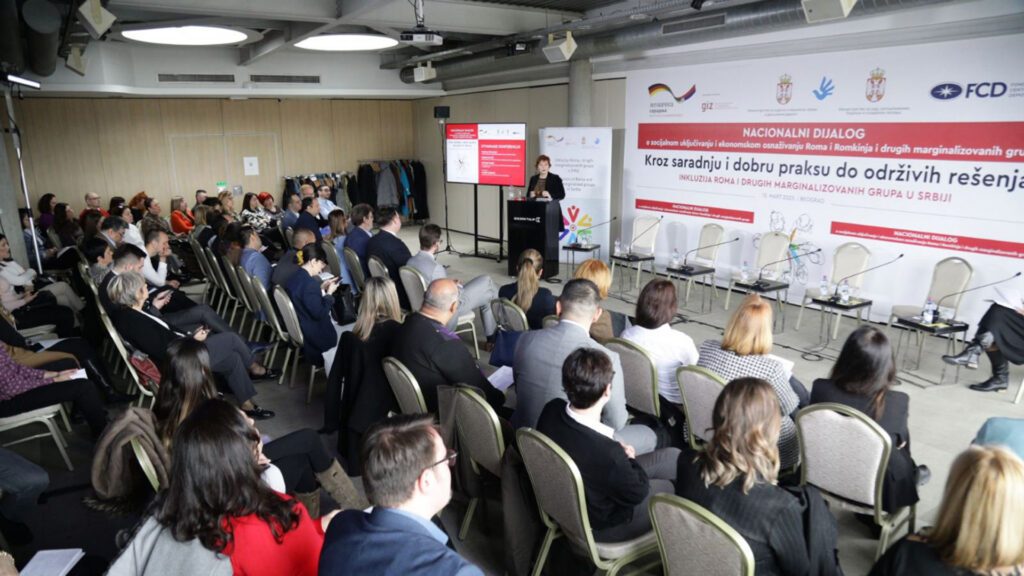
We organized two National Dialogues titled “Through Cooperation and Good Practice to Sustainable Solutions” in the form of conferences, together with the German development cooperation program and in cooperation with the relevant ministries for human and minority rights and for labor, employment, and social issues.
We established a Platform for the exchange of experiences between partner cities and municipalities on the topic “Development Planning and Inclusion of Roma Men and Women at the Local Level”. The goal is the exchange of experiences and practices, innovations, and lessons learned between partner cities and relevant stakeholders for development planning and Roma inclusion at the local level, to plan local policies and measures more successfully. The platform was held as part of the “Inclusion of Roma and other marginalized groups in Serbia” program, financed by the German Federal Ministry for Economic Cooperation and Development (BMZ). The goal of this program module is to improve the framework for implementing the “Strategy for the Social Inclusion of Roma in the Republic of Serbia for the period 2016–2025.”
ACHIEVED RESULTS:
- We prepared 4 expert analyses related to the evaluation of previous projects, analysis of good practice in Serbia and the region, analysis of the economic position of Roma, and analysis of existing public policy documents.
- Recommendations were formulated and discussed with key stakeholders through a series of meetings. A multisectoral approach and insistence on the interconnection of strategies and action plans were applied in drafting the Recommendations.
- The Recommendations contributing to the effective implementation of the Strategy for the Social Inclusion of Roma Men and Women in Serbia for 2022–2030, relating to systemic solutions for improving the position of members of this vulnerable group in the labor market, were presented to the public.
- Cooperation was established with the Ministry of Labor, Employment, Veteran, and Social Affairs, the Ministry of Human and Minority Rights and Social Dialogue, the Commissariat for Refugees, the National Employment Service, local governments, the public sector, and civil society.
- Together with experts and policymakers, we opened panels on concrete solutions:
- Social entrepreneurship as a potential for including the most vulnerable groups in the labor market
- Education, both formal and non-formal, as one of the ways out of poverty and social exclusion
- Experiences and lessons learned were presented on the topics: Local Action Plans for Roma Inclusion, Gender Equality, Intersectoral Cooperation in the Field of Roma Inclusion and Returnee Reintegration, Perspectives of Users for Employment and Economic Empowerment of Roma Men and Women.
- Successful experiences were shared by representatives of local governments from Pirot, Kragujevac, Aleksinac, and Subotica.
Center for Democracy Foundation