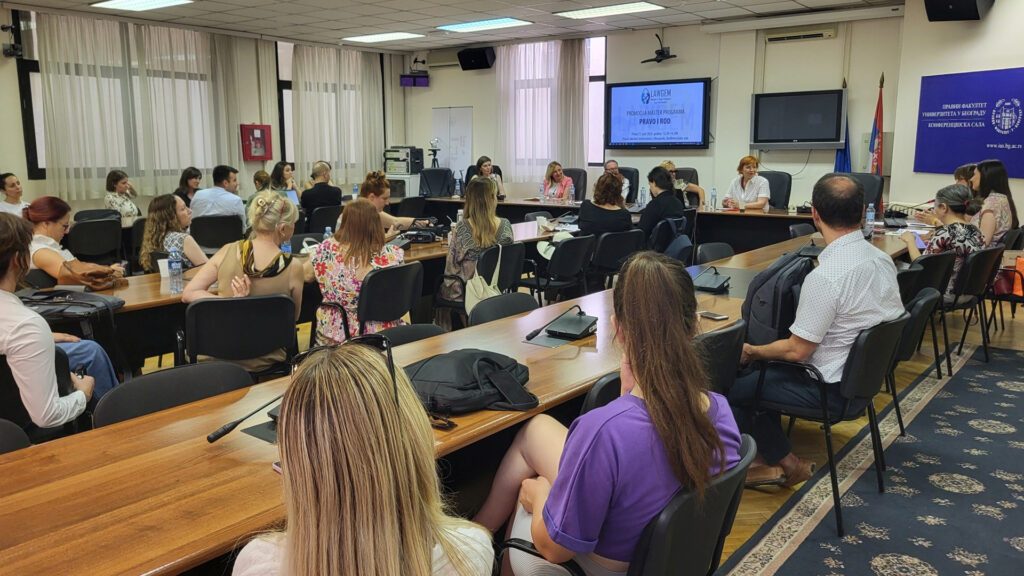
The Faculty of Law of the University of Belgrade accredited a new master’s programme entitled Law and Gender in the spring of 2024, developed the previous year by professors from Belgrade in cooperation with colleagues from several European universities: Cadiz (Spain), LUMSA (Italy), Örebro (Sweden), and Saarland University/Europa Institut (Germany).
The ERASMUS Plus KA203 project LAWGEM, also known as “A New Quality in Education for Gender Equality – Strategic Partnership for the Development of the Master’s Programme Law and Gender,” introduces a new quality in education by embedding a gender perspective that has been neglected for centuries up to the present day. In line with the civilizational standards of the contemporary era, it is expected that the gender perspective will take its deserved place at all levels of education and within higher education.
 The Center for Democracy Foundation participates in the LAWGEM project as an associate media partner to the Faculty of Law of the University of Belgrade, together with the Commissioner for the Protection of Equality. At the same time, the project represents an important contribution to the implementation of the United Nations 2030 Agenda Sustainable Development Goals, particularly those related to quality education and gender equality.
The new master’s programme is conducted in English. It is intended for graduates of law, social sciences, and humanities, who, upon completion, obtain the title “Master of Laws in Law and Gender.”
The objectives of the programme include providing appropriate knowledge and competencies for performing both legal and non-legal roles related to gender mainstreaming in public policies across all areas relevant to the creation of legal norms, as well as the application of law in the judiciary, decision-making within public administration bodies, and the development of national, regional, and local regulations concerning the economy, social security, media, and culture, as well as gender-competent higher education in the fields of law and other social sciences and humanities.
Among the numerous activities of the LAWGEM programme, several key ones stand out:
– The Spring School – Law and Gender is being held for the second time at the Faculty of Law in Belgrade, following the first Summer School in 2023, which served as a pilot phase of the project.
– Conferences have been held in Belgrade, Cadiz, and Saarbrücken on topics such as Gender (In)equality of Persons with Disabilities, Gender-Competent Legal Education, Gender and Law in Practice and Education, and New Pathways to Gender Equality.
– The LAWGEM programme has led to the creation and publication of books of significant value for professors, students, legal practitioners, and all those interested in gaining a deeper understanding of contemporary gender-sensitive issues.
– The textbook Gender-Competent Legal Education is the result of joint work by five European universities participating in the project and represents a reconstruction of specific areas of legal education from a gender perspective.
– The book series Gender Perspectives in Law, authored by contributors from several continents and edited by Professor Dr Dragica Vujadinović and Professor Dr Ivana Krstić, addresses contemporary gender-sensitive legal issues.
– A collection of papers entitled Intersectional Discrimination of Women and Girls with Disabilities and Instruments for Their Empowerment.
ACHIEVED RESULTS:
- A fully innovative, systemic curriculum for master’s legal studies covering all relevant areas of legal education and legal practice, as well as non-legal fields such as economic analysis of law, criminology, and socio-psychological areas of research and knowledge.
- A textbook and learning materials relevant to the master’s programme Law and Gender.
- The establishment of a legal clinic.
- An online platform for lifelong learning on gender issues, aimed at raising awareness of gender equality and improving the knowledge and practices necessary to combat all forms of gender-based discrimination, violence, and sexual harassment.
For more information about the project click here: http://lawgem.ius.bg.ac.rs
Center for Democracy Foundation