

The public reading of the European Commission’s Report on Serbia, organized by the Center for Democracy Foundation and the Center for Contemporary Politics, with the support of European Western Balkans, has become a tradition for a specific reason – it provides citizens with a unique opportunity to learn where our country stands on its path to the European Union.
Year after year, we strive, through democratic and open public discussion, to contribute to a better understanding of the EU integration process, more effective reforms, and stronger public support for Serbia’s European path. We present findings on the current state and give recommendations for improving reforms in key areas such as, among others, democratic institutions and public administration reform; judiciary and fundamental rights; justice, freedom, and security; economic and monetary policy; social policy and employment; foreign, security, and defense policy; environmental protection.
Why a public reading?
According to participants in our discussions, dominant media outlets, which are under state control or influence, regularly portray the European Commission’s assessments of quality of life, institutional conditions, and reform steps as more successful than they really are. In reality, the EC reports are much closer to the assessments made by civil society organizations and can be summed up in one conclusion: for years there has been no visible progress in Serbia’s level of preparedness for membership, which shows how genuine the government’s will is for reform processes in EU integration.
The latest European Commission Report on Serbia noted only minimal progress by our country on its path to joining the European Union. The document is realistic, as it provides an accurate “list” of slight improvements and accumulated problems in key areas – this was the shared assessment emerging from the public reading.
What needs to be done?
To speed up Serbia’s European path, the authorities – that is, decision-makers – need to take seriously not only the European Commission’s recommendations but also those of civil society, which remains the target of verbal attacks. In this context, it is necessary to implement in practice the laws whose adoption the EC welcomed, relating to the electoral process, freedom of expression and media, and respect for human rights.
The current European Commission Report has been described as clearer, more understandable, more concise, and showing that Serbia’s progress in the EU integration process is very weak and limited, with one of the biggest criticisms being that Serbia’s institutions are weak. The EC devoted particular attention to the work of the parliament. Also, non-alignment with foreign policy is one of the major objections to Serbia in the Report.
The European Commission Report states that the accession process requires greater political will, strengthening human and financial capacities in all institutions dealing with accession, changing the way Serbian officials speak about European integration and the European Union, and reducing disinformation and the influence of foreign actors.
At the public reading of the report, traditionally organized by the Center for Democracy Foundation and the Center for Contemporary Politics, the most important findings of the European Commission in various areas are presented, the Serbia report is compared with reports on other Western Balkan countries, and civil society organizations long dedicated to Serbia’s European integration give recommendations for improving reforms and the EU integration process.
Center for Democracy Foundation
Public reading of the European Commission’s report on Serbia 2025

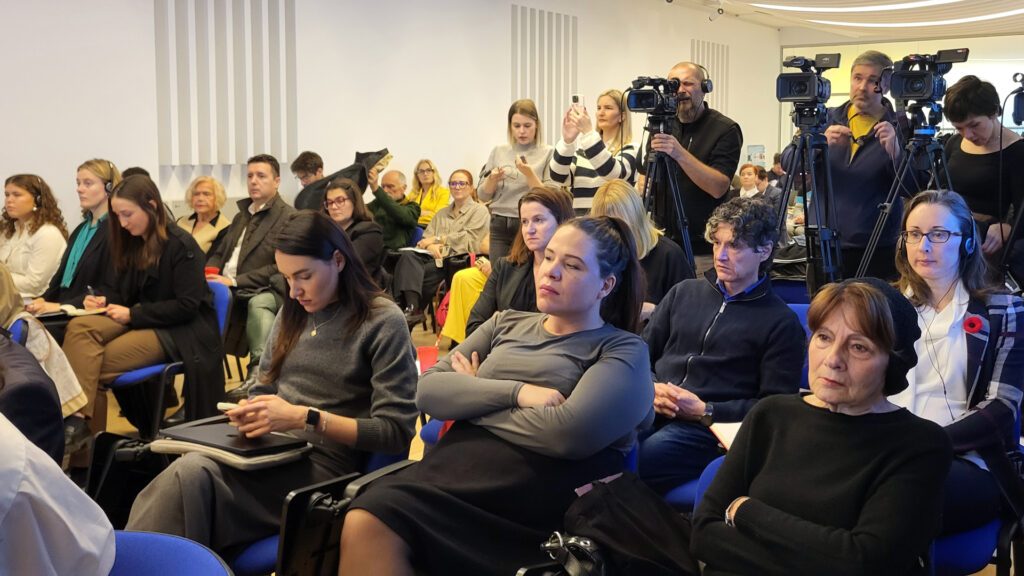

Public Reading of the European Commission Report on Serbia 2024


